
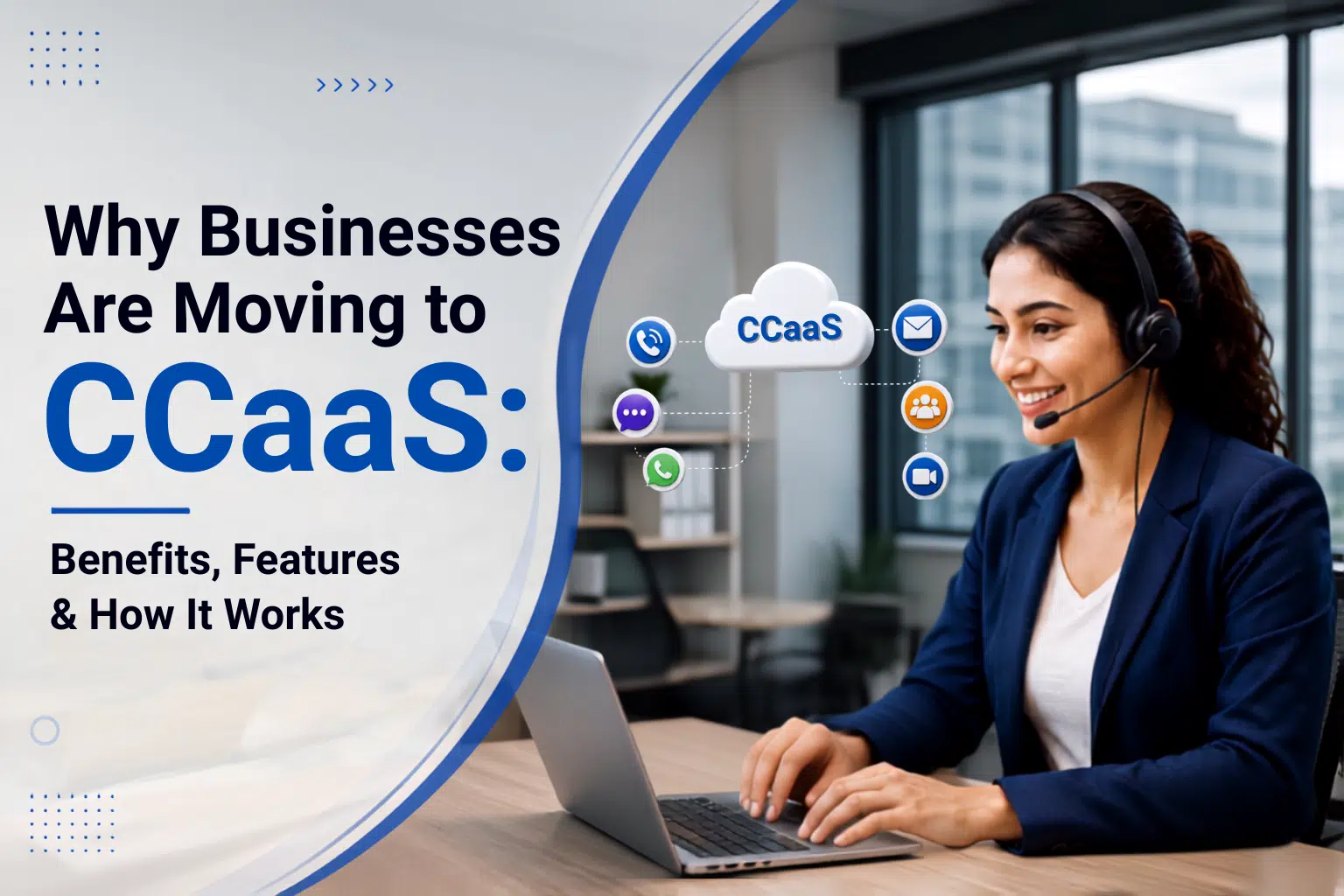
CCaaS, or Contact Center as a Service, is turning heads on how businesses think about communication. The main hurdle today isn’t just handling more interactions – it’s managing complexity across people, processes, and channels.
Every disconnected tool leaves a gap. Every manual handoff adds friction. As a business grows, these small gaps turn into real efficiency problems – which is why more companies are moving toward a connected approach that adapts faster and turns communication data into better decisions.
What is CCaaS?
Literally, Contact Centre as a Service means running your contact centre in the cloud instead of manually maintaining servers and on-site hardware. It pulls communication, routing, automation and analytics into one place, instead of leaving them in parts across separate systems.
Most cloud call center solutions today also plug into your CRM and other business tools, so information doesn’t stay locked in silos. Basically, CCaaS turns the contact centre into something software runs, not something hardware dictates – which means businesses get a lot more say in how interactions are handled, tracked, and improved over time.
Why Businesses Are Actually Moving
Scaling Without Rebuilding Infrastructure
Business volumes rarely stay constant – a sales push, seasonal demand, or a new market can all mean more agents and channels overnight. Traditional infrastructure makes that painful, requiring hardware and IT intervention. Contact Center as a Service model lets businesses scale users and channels as needs shift, without the heavy lifting.
Bringing Multiple Channels into One Operation
Customers move between WhatsApp, chat, and calls within a single conversation. When channels sit in isolation, agents end up juggling disconnected systems. A solid CCaaS platform brings these touchpoints together, so the value isn’t just “more channels” – it’s managing them as one strategy.
Cutting Manual Work Through Automation
CCaaS automates repetitive processes through IVR, intelligent routing, chat bots, and AI assistance. This sets agents free from digging for information, letting them focus on interactions that actually need human judgment.
Turning Every Interaction into Usable Data
Calls, chats, and response times all say something about how operations are running – but scattered data isn’t useful data. Contact Center as a Service centralizes this information, helping managers spot trends and bottlenecks as part of daily management, not quarterly reports.
Features Worth Paying Attention To
- Omni-channel Communication – Voice, email, chat, WhatsApp, and SMS managed through a single connected platform.
- Intelligent Routing – Interactions routed by skill, priority, or business rules, not just to the next free human agent.
- Smart Dialers – Predictive, preview and progressive dialling that streamline outbound campaigns.
- AI-Powered Agent Assist – Real-time suggestions and summaries that make manual effort go down immensely mid-conversation.
- Quality Management and Analytics – AI-driven review that surfaces patterns across interactions at length.
- CRM and Business Integrations – The backbone of strong cloud call center solutions – agents get context without switching screens.
What Actually Changes After the Move
It’s more than a tech migration – it changes how operations run day to day. Voice, digital channels, automation, and CRM data – sit within one connected environment. Agents get faster access to information, managers get better visibility, and scaling no longer means rebuilding the system from scratch.
What to Look for Before Choosing a Platform
Feature lists shouldn’t drive the decision alone. Worth asking: how well does it scale, does it integrate with your CRM, how much can genuinely be automated, and can it support distributed teams as needs evolve? The best platform is the one that fits your operations, not the one with the longest spec sheet.
Where Teckinfo Solutions Fits
Teckinfo Solutions addresses this shift through ID Cloud, a unified Contact Center as a Service platform bringing communication, automation, AI and analytics together. It combines omni channel communication, smart dialers, intelligent IVR, CRM integrations, AI voice and chat bots, agent assist and AI-powered quality management – helping businesses move past fragmented systems.
Conclusion
The shift to CCaaS reflects a bigger change in how businesses run communication. It’s about scaling faster, connecting channels, automating repetitive work and putting interaction data to real use. As platforms like Teckinfo’s ID Cloud continue blending cloud communication with AI, the real question isn’t whether to move to the cloud – it’s how intelligently a business can operate once it gets there.
FAQs
What does CCaaS stand for?
Contact Center as a Service – a cloud-based approach to managing business communication and interaction workflows.
Why are businesses adopting CCaaS?
It takes a lot of the grunt work off agents’ hands, routes conversations more sensibly and pulls all the data into one dashboard instead of ten different tools – so managers aren’t chasing information after the fact.
How does Contact Center as a Service improve operational efficiency?
CCaaS improves operational efficiency by automating workflows, optimizing agent performance, streamlining communication, enabling real-time analytics, and reducing infrastructure and operational costs.
Is CCaaS suitable for growing businesses?
Yes, and honestly it’s built for exactly that. Adding a new agent or channel is more of a settings change than a construction project.
How is Contact Center as a Service different from a traditional contact center?
Old-school setups run on physical servers and a handful of disconnected tools. CCaaS just moves all of that into the cloud and ties it together, so nothing keeps on working in isolation anymore.