
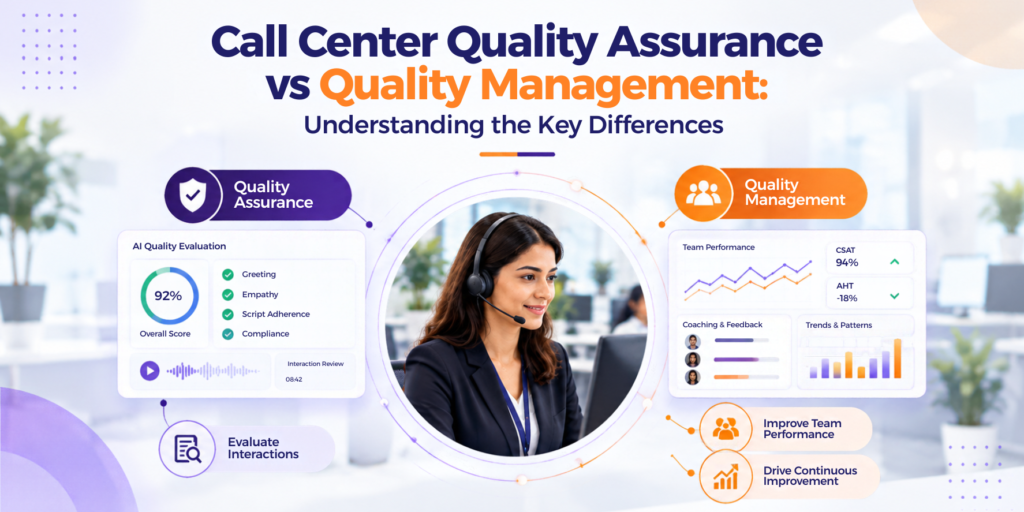
Here is something most call centers get wrong. Quality assurance and quality management are not the same function. One checks whether a single interaction met the standard. The other takes every metric against the preset parameters to figure out what needs to change across the operation. Treating them as the same thing means a business is measuring quality without actually doing anything about it.
What is Quality Assurance in a Call Center?
Call center quality assurance is the process of monitoring and evaluating customer interactions to make sure agents are providing high-quality service. It looks at things like communication, accuracy, professionalism and how closely agents stick to company policies. QA also shows where agents can improve and that feeds into feedback and training. The overall aim is to keep customers satisfied and service quality consistent from one call to the next.
Quality Assurance vs Quality Management: The Actual Difference
Quality assurance answers one question about one interaction. Did this call, chat or email hit the required standard? The scorecard covers agent greeting and professionalism, empathy and active listening, script adherence, regulatory disclosures, internal policy compliance and issue resolution.
Quality management is what happens after. Take those scores across hundreds of interactions. Where is the same gap showing up repeatedly? Is a compliance disclosure being missed by one agent or an entire team? Are soft skills like empathy consistently lower on certain interaction types? What does the pattern say about a training gap or a process failure?
Call center quality assurance is the snapshot. Quality management is the root-cause analysis those snapshots make possible.
Why Quality Management Matters at Scale
A supervisor reviewing ten calls a week is spot-checking. Not running a quality program. At any real volume, the gap between those two things becomes a serious operational problem.
Compliance issues go undetected across hundreds of interactions before the pattern surfaces. Agent skill gaps repeat without triggering a coaching response. Customer pain points pile up without connecting back to a process failure anyone has caught. Top-performing agents go unrecognized because the sample is too small to surface consistent high performance alongside the gaps.
An AI QMS fixes this by reviewing every interaction, not a sample. Compliance issues get flagged automatically. High performers get identified and benchmarked so the team has a real standard to coach toward, not just a list of what fell short. Internal QA scores reviewed alongside CSAT and NPS data close the loop between what evaluators score and what customers actually experience. An agent scoring well internally but generating low satisfaction scores points to a gap in how quality is being defined, not just delivered. Manual review misses that entirely.
Manual vs AI-Powered Quality Management
Traditional quality monitoring depends on supervisors manually reviewing a selected sample of interactions. A supervisor pulls a handful of calls, scores them against a rubric, and flags what stands out. Useful, but limited. Most interactions go unreviewed. The sample reflects whoever happened to get pulled that day, not the full picture of what the team is doing.
AI-powered quality management system changes the scale entirely. Large volumes of conversations evaluated automatically. Specific patterns identified across the full interaction set. Sentiment detected in real time. Predefined quality parameters assessed consistently, without the variability that comes with different reviewers interpreting the same scorecard differently. Instead of visibility into a small sample, organizations get a broader, more accurate view of customer conversations and agent performance across every channel.
How AI Improves Call Center Quality Management
AI brings automation and consistency into several parts of the quality management process.
100% Interaction Evaluation: AI-powered systems evaluate interactions at scale rather than depending on manually selected samples. Every call, chat, email and message gets reviewed. Nothing falls through the gap between what a supervisor had time to pull and what actually happened across the operation that week.
Automated Quality Scoring: AI assesses conversations against predefined quality metrics consistently across every interaction. Scoring does not shift depending on which reviewer is on that day or how they interpret a rubric. The same criteria apply every time.
Sentiment and Conversation Analysis: AI identifies signals within conversations that indicate positive, negative or shifting customer sentiment. These insights help teams catch interactions trending in the wrong direction before they result in complaints, escalations, or lost customers.
Compliance Identification: AI-based monitoring checks conversations against configured rules and quality parameters automatically, flagging potential compliance issues without relying on a reviewer to catch them in a manual sample.
Agent Performance Insights: Quality data surfaced across the full interaction set highlights recurring strengths and improvement areas at both the individual and team level. Coaching becomes more focused because it is built on patterns across real interactions rather than observations from a handful of reviewed calls.
How AI-Powered QMS Changes the Game
Manual monitoring has a ceiling. A supervisor can only review so many interactions. Whoever they pull on a given shift sets the sample. Different reviewers read the same rubric differently. Results are inconsistent. Most of the operation goes unchecked.
An AI-driven QMS removes that ceiling. Every interaction across every channel gets evaluated against the same criteria. No variation based on who is reviewing that day. What that looks like operationally:
Full-volume interaction evaluation- across voice, chat, email and messaging. No selective sampling. Complete coverage.
Automated scoring- applying predefined parameters consistently across every interaction. Reviewer variability removed from the process.
Real-time sentiment analysis- catching conversations trending negative while the interaction is still happening, before a complaint gets filed.
Programmatic compliance checks- running on every call automatically, not just the ones someone happened to pull for manual review.
Agent benchmarking- identifying top performers and using their interaction patterns to set coaching standards across the team.
Building a Call Center Quality Assurance Strategy That Actually Works
Technology scales a quality program. It does not build one. That part has to come first.
Start by defining what quality actually means for the business. Not a generic vendor scorecard. Real criteria built around actual operational goals: customer experience outcomes, regulatory compliance requirements, resolution rates, and soft skill standards like empathy that affect satisfaction scores even when technical compliance is met.
Once scorecards reflect real goals, an AI quality management system makes the rest realistic. Quality findings get reviewed for patterns across every interaction instead of a handful of scores from a small sample. Call center QA data cross-referenced with CSAT and NPS surfaces the blind spots internal scoring alone would miss. Coaching tied to a specific interaction moment and a specific scorecard criterion changes behavior. Coaching tied to a vague trend usually does not.
Where Teckinfo Fits In
Teckinfo puts AI-powered quality monitoring, omni-channel interaction analytics, conversation intelligence and agent assistance into one platform. Evaluating interactions and acting on what they reveal does not need two separate tools or two separate workflows. Raw conversation to coaching decision, without the manual bottleneck that limits how much any team can realistically get through.
Conclusion
Call center quality assurance evaluates an interaction. Quality management determines what thousands of those evaluations say about the operation and what needs to change as a result. As volumes grow and channels multiply, manual review cannot keep pace with either job. An AI-powered QMS handles both at scale, turning quality from something audited occasionally into something built into how the operation runs every day. That is what Teckinfo is built around.
Frequently Asked Questions
What is the difference between quality assurance and quality management in a call center ?
Call center QA focuses on reviewing interactions against defined criteria such as communication, compliance, empathy and resolution. AI quality management goes a step further by using these evaluations to identify recurring issues, improve agent performance, support coaching and maintain consistent service standards.
What does an AI-powered QMS do in a contact center?
An AI-powered QMS evaluates customer interactions at scale across voice and digital channels. It can automate quality checks, apply consistent scoring, identify compliance gaps, detect customer sentiment, and highlight coaching opportunities without relying only on manual reviews.
Why is manual quality monitoring not enough for modern call centres?
Manual monitoring usually covers only a small sample of customer interactions. As interaction volumes increase across voice, chat, email, and messaging channels, reviewing every conversation becomes difficult. AI-powered quality monitoring helps businesses evaluate more interactions consistently and identify issues that may otherwise go unnoticed.
How does quality management improve agent performance?
AI-driven quality management connects agent coaching with actual customer interactions and specific areas for improvement. Managers can identify recurring skill gaps, understand where agents need support and use high-performing interactions as benchmarks for coaching. Comparing quality scores with customer feedback can also reveal areas that may not be visible through internal evaluations alone.
What should a call center quality assurance strategy include?
A strong quality assurance and management strategy should include clear scorecards based on business goals, coverage of compliance and customer service standards, consistent evaluation across channels, regular review of customer feedback, and coaching based on actual interaction data. It should also help managers identify recurring issues and take action at both the agent and team level.