
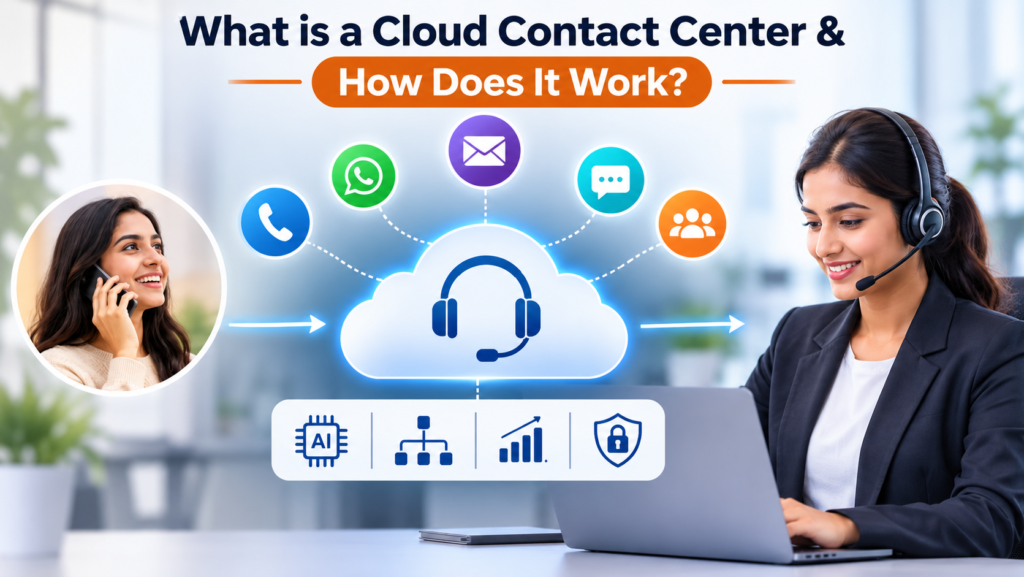
Traditional contact centers typically depend on hardware and software located on site, making them expensive to maintain and difficult to scale. When customer demand changes, expanding infrastructure or upgrading existing systems can take a lot of time, effort and investment. A cloud contact center offers a more flexible approach to customer communications. It enables businesses to handle customer interactions through an internet-based platform without depending solely on physical infrastructure.
In addition to flexibility, cloud contact centers have features that help agents provide consistent support across multiple channels, from voice calls to email, live chat and messaging platforms. Integration with CRM systems and other business applications also allows agents to access relevant customer information and manage interactions more efficiently.
In this guide, we’ll discuss what a cloud contact center is, how it works, the key features and benefits, and how businesses can choose the right solution to improve customer service and streamline contact center operations.
What is a Cloud Contact Center?
A cloud contact center is a software platform that allows organizations to handle customer interactions via the internet instead of using only physical equipment installed at their premises.
It enables customer support teams to handle voice calls, emails, live chats, messaging apps interactions and other channels of communication from a single system. Depending on permissions and internet connectivity, agents and supervisors can access the platform remotely.
Cloud contact center software can also include features like AI-powered IVR, automatic call distribution, call recording, reporting, chat bots and AI-powered quality management. These capabilities empower businesses to manage customer conversations, track team performance, and ensure consistent service across various channels.
How Does a Cloud Contact Center Operate?
A cloud contact center connects customers, agents and business communication systems using a cloud-based platform. Most of the core infrastructure is managed by the service provider, which reduces the need for businesses to maintain their own hardware in their premises.
Cloud contact centers runs on cloud-based servers, where the contact center software, communication channels and customer data are stored, rather than being entirely on on-premises hardware. Agents can log in securely from anywhere to manage customer interactions over voice calls, emails, live chat, WhatsApp and social media, all through a single interface.
When a customer calls a business, the system uses AI-driven IVR, intelligent call routing and predefined workflows to route the interaction to the right agent or department. Features such as CRM integration, AI-powered voice bots, agent assist and the AI quality management system enable agents to resolve queries faster, automate repetitive tasks and improve service quality.
Managers can track performance with real-time dashboards, call recordings and analytics. Because it is a cloud-based platform, companies can scale operations, add new channels and support remote teams without major investments in physical infrastructure.
Traditional Contact Centers vs. Cloud
The biggest difference is in the way infrastructure is deployed and managed.
Traditional contact centers tend to depend on on-premises hardware, local infrastructure and internal maintenance. In a cloud contact center, agents access provider-hosted infrastructure over the internet.
Traditional systems might give you more control over some parts of the infrastructure, but cloud solutions often offer more flexibility in terms of remote access and scaling. The right choice depends on budget, security needs, existing systems, customization needs and internal IT capabilities.
Cloud Contact Center and Cloud Call Centre
A cloud call center is primarily concerned with inbound and outbound calls. It allows businesses to respond to customer enquiries, run sales campaigns, route calls to appropriate agents and track performance without depending on onsite telephony infrastructure.
A cloud contact center, in contrast, offers broader communication capabilities, including voice calls, email, live chat, SMS and other messaging channels. Depending on the platform, it can also aggregate customer interaction history, helping agents maintain context across channels and provide more consistent support.
The main difference between these solutions is their scope. Cloud call centers are focused on voice-based communication, while cloud contact centers support multiple communication channels. A cloud call center can provide features like automatic call distribution, intelligent IVR, call recording and outbound dialling. Cloud contact centers can offer these features along with omnichannel communication, CRM integration, digital interaction routing and AI-powered tools for agent assistance and quality management.
Cloud Contact Center Software Advantages
● Less equipment needed: Cloud contact centres reduce hardware and maintenance needs, but subscription, usage, integration, and implementation costs still apply to businesses.
● Remote Work: Agents can work from anywhere as long as security and system requirements are met. This allows for distributed teams.
● Easy growth: Businesses can add agents, change capacity or enable features without major new equipment.
● Better customer service: Smart routing, customer information and connected channels can reduce transfers, repeated explanations and waiting time.
● Clearer performance information: Detailed reports and analytics help managers identify delays and make better decisions.
● Access to newer tools: Updates or optional plans may give you access to AI, automation, speech analytics and service-quality tools from cloud providers. .
Main Features
● Unified customer experience: Brings together channels and customer information so that agents can keep context between calls, email, chat, and messages.
● Smart call routing: Calls are routed to the most appropriate agent based on skills, language, availability, or predefined rules. This limits excessive transfers and fairly distributes work.
● Self-service: Chatbots, voice bots and virtual assistants answer common questions, give information and guide customers through simple tasks. This leads to faster replies and allows agents to focus on complex problems.
● AI agent assist: Helps agents by providing relevant customer information, knowledgbase articles, suggested responses and live guidance during interactions.
● AI quality checks: These tools examine multiple interactions to identify service issues, patterns of problems, risks of rule violations and coaching needs.
● Reports and analysis: The platform enables managers to look at call volumes, handling times, service levels, agent output and customer satisfaction.
● Integrations with other tools: CRM and helpdesk integrations allow agents to view customer profiles and past communications without toggling between different apps. They can also make calls, update records and save interaction details from the CRM.
How to Pick the Right Cloud Contact Center
Businesses need to assess their operational requirements before choosing a platform and not just choose a solution based on features. Here’s how:
● Mediums of communication: Make sure the platform can handle the channels your customers are on.
● AI capabilities: Determine if features such as AI agent assist, speech analytics and AI QMS are right for your business.
● Integration: Ensure it integrates with your CRM, helpdesk and other business apps.
● Security and compliance: Review controls around access, encryption, where data is stored, how long it’s stored, and any regulatory requirements that apply.
● Scalability: Make sure the solution can scale with you and can handle changes in interaction volumes.
● Pricing: Compare subscription fees, usage charges, integration, support and implementation costs.
● Reporting: The reports you have should give your supervisors the insights they need.
Conclusion
A cloud contact center is not only an internet calling system. It provides a centralized platform to help businesses manage customer communications, support agents, track service quality and improve operational efficiency.
Features like omni-channel communication, intelligent routing, agent assist and AI-powered quality management enable organizations to build more connected customer service operations while keeping pace with evolving customer expectations.
ID Cloud by Teckinfo helps organizations to explore smart contact center solutions that help streamline customer interactions, support agent performance and enhance quality management. Combining contact center technology with AI-powered capabilities enables businesses to pursue more efficient operations and deliver improved customer experiences.
Frequently Asked Questions
1. How is AI transforming cloud contact centres?
AI is bringing virtual assistants, live guidance for agents, predictive analytics, sentiment analysis and automated quality checks. These tools can boost productivity, personalize service, solve problems quicker and create a more consistent customer experience.
2. How does a cloud contact center improve customer experience?
Cloud contact centres improve customer experience by combining voice, WhatsApp, email and chat into one platform. Smart routing means shorter wait times. Real-time agent assistance, real-timecustomer insights mean faster resolutions, personalized communication, consistent quality of service and higher customer satisfaction across all touchpoints.
3. Does a cloud contact center support inbound and outbound calls?
Yes. Inbound calls help businesses to answer customer questions. Outgoing tools such as predictive, progressive, preview and power dialling assist with sales, follow-ups and customer campaigns. Features vary between providers and plans.
4. How is a Cloud Contact Center Different from a CCaaS Platform?
CCaaS is an acronym for contact center as a Service. It is a cloud-based delivery model where a provider offers contact center software and related capabilities as a service. CCaaS is the service model that gives you the bigger solution you use to manage customer interactions – a cloud contact center.
5. Does it integrate with CRM software?
Yes. Our ID Cloud software seamlessly integrates with all leading CRMs. This enables agents to see customer profiles, previous conversations, and account information as per authorization. Depending on the system, they may also be able to make calls, update records and save conversation details within the CRM.