
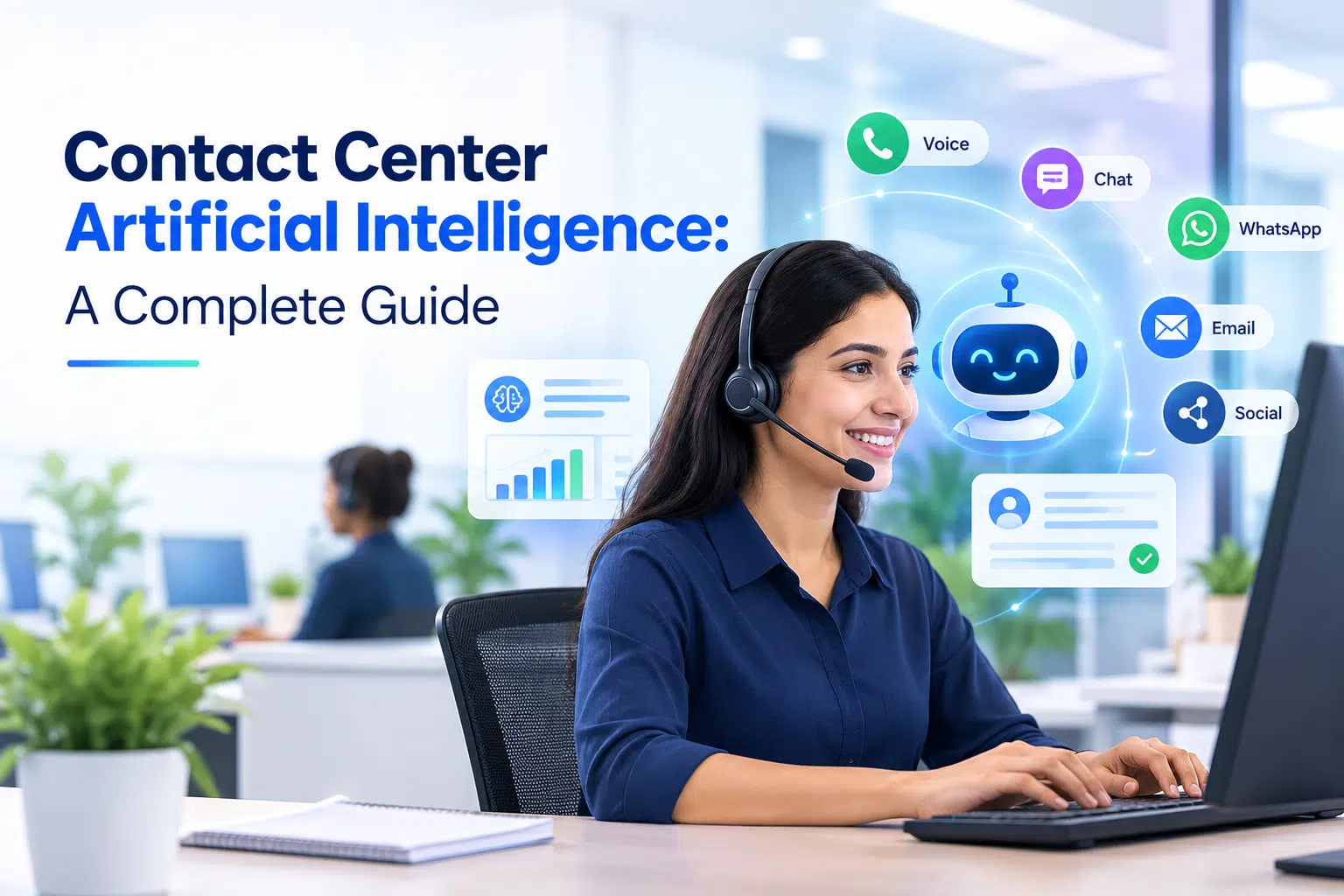
Customer expectations are rapidly changing. Companies need to offer quicker answers, personalised support, and consistent service across a range of channels. Traditional contact centres often struggle with high call volumes, repetitive questions, rising operational costs and increasing customer expectations.
Contact center artificial intelligence is transforming how businesses manage customer interactions by enabling intelligent automation, real-time assistance, and data-driven insights. These AI-powered capabilities help organizations improve customer satisfaction, streamline operations, reduce response times, and enhance overall efficiency. Companies like Teckinfo help enterprises identify and implement advanced contact center and communication technologies that enable faster customer interactions, smarter workflows, and more personalized customer experiences.
The guide covers contact center AI, its core technologies, benefits, use cases, implementation best practices and future potential.
What is AI in contact center?
Contact center artificial intelligence is the application of machine learning, natural language processing (NLP), speech recognition, sentiment analysis, and conversational intelligence (AI) technologies to improve customer interactions and operational efficiency.
These solutions can comprehend customer queries, automate repetitive tasks, analyse conversations, detect sentiment, and provide relevant information to agents during interactions.
For instance, an AI voice bot can take care of the simple repetitive questions and an AI agent assist solution can suggest responses and source relevant information during live conversations.
Teckinfo’s contact center technology products are a stepping stone for companies wanting to modernise client engagement through more efficient communication workflows.
Core Technologies Powering Contact Center AI
Several technologies work in concert to make AI in contact center effective.
Conversational AI: Enables virtual agents and chat bots to understand customer intent and respond naturally, either by voice or text.
Natural Language Processing: Helps systems understand human language, identify intent, meaning and address customer requests more accurately.
Machine Learning: Recognises patterns in past interactions and helps improve routing, forecasting and engagement with clients.
Speech Analytics: Analyses spoken conversations and provides useful information for businesses such as sentiment, recurring issues, and compliance concerns.
Generative AI: Generates context-aware responses, summarises conversations, and provides agents with relevant information.
Together, these technologies provide smarter automation, personalised interactions and data-driven operational improvements.
Advantages of using AI in Contact Center
Enhanced Customer Experience
AI enables businesses to provide faster answers and consistent support. Intelligent routing connects callers to the right agents, while virtual assistants handle routine queries without making people wait unnecessarily.
Increased Productivity for Agents
AI eliminates repetitive admin tasks such as manual searching, note taking and post-call documentation. Agents can focus more on problem-solving and building meaningful relationships with customers.
Lower Operating Expenses
Businesses can manage large volumes without adding proportionate staff by automating repetitive interactions. The intelligent allocation of resources also allows teams to make better use of existing capacity.
Better Quality Monitoring
AI-powered quality management system can review a greater share of customer conversations than classic sample-based reviews. Businesses can identify communication gaps, compliance risk and coaching opportunities more consistently.
Data Driven Decisions
Conversation analytics reveal consumer tastes, common complaints, sales opportunities, and service bottlenecks. These insights help managers to improve training, processes and client engagement strategies.
Key Uses of Contact Center Artificial Intelligence
- AI Voice Bots & Chat bots , Virtual assistants: answer frequently asked questions, give account information, schedule appointments and provide 24/7 support. Complex issues can be handed over to human agents when necessary.
- Smart Call Routing: AI analyses customer intent, available context and agent skills to route interactions to the right resources.
- AI Agent Assist: Real-time assistance delivers relevant knowledge, suggested responses, compliance reminders and next-best-action recommendations as agents interact with customers.
- AI-driven Quality Assurance: Automated conversation scoring allows you to measure the quality of communication, adherence to guidelines, customer sentiment and agent performance across interactions.
- Predictive and Intelligent Dialling: AI-driven outbound operations are able to prioritise leads, optimise calling schedules and support follow-up strategies based on customer and campaign data.
- Conversation Intelligence Platform: Companies can evaluate interactions to identify objections, buying signals, dissatisfaction, and opportunities to improve service or sales performance.
Coupling the right communications platforms with AI capabilities enables businesses to build more connected and efficient client engagement processes.
How to Successfully Implement AI in Contact Center
It’s not just about taking the technology because it’s there, but having a clear strategy for successful implementation.
Step 1: Identify operational issues. Decide whether your priority is to reduce wait times, improve quality monitoring, increase agent productivity or improve outbound engagement.
Next, evaluate current systems, customer information, communication channels and integration requirements. Choose solutions that integrate with your CRM, telephony platform, and business applications.
If you are looking for contact center infrastructure and communication solutions that meet your business requirements, technology providers such as Teckinfo can be considered. Consider the available capabilities, integration options, scalability and support before making a decision.
Start with a focused use case like automated FAQs or agent assistance. Deploy on a pilot, collect feedback and measure results before expanding deployment.
Establish performance indicators like first contact resolution, average handling time, customer satisfaction, quality scores and automation success rates.
Finally, train employees, leave room for human escalation, and review AI performance regularly. Responsible deployment requires strong data governance, privacy protections, and appropriate oversight by humans.
Issues and Concerns
However, some management issues need to be addressed for contact center AI to be successful. Low quality data may result in inaccurate recommendations, and complex accents, ambiguous requests, and emotional conversations may be difficult for automated systems.
Companies need to protect sensitive customer information, review relevant privacy regulations, and check AI-generated outputs for mistakes or bias. So, businesses should go for solutions like ID cloud by Teckinfo which has comprehensive platform security features like masking, encryption, multi factor authentication, access control restrictions and has the required ISMS and VAPT certifications.
Customers should be able to get human assistance when their concerns cannot be resolved by automation. Open communication, ongoing testing, and training of employees all help keep trust alive.
The Future of Contact Center Artificial Intelligence
Contact center artificial intelligence (AI) is moving toward more contextual, proactive, and personalised interaction with clients. AI agents will work alongside human employees, summarise interactions, suggest next steps, and automate routine workflows.
Advances in generative AI and real-time analytics will allow businesses to better understand customer needs. Organisations that blend the right technology with human judgement and accountability will be better positioned to deliver consistent customer experiences.
Teckinfo and other contact center providers are in a market where intelligent communication, automation and scalable client engagement are most important business priorities today.
Conclusion
AI in contact center helps organisations transform customer service with smart automation, real-time assistance and useful insights. The right technologies, combined with existing systems and human supervision, can help organisations improve client experiences and create scalable operations.
The right combination of technology, strategy and people can help organisations deliver more efficient, consistent client engagement. Teckinfo can be your technology partner in this journey.
FAQs
1. What issues can contact center AI solve for businesses?
AI in the contact center can help reduce long wait times, customers, inconsistent quality of service, manual workflows and lack of visibility into customer conversations. It helps businesses to handle repetitive queries and make their operations more efficient.
2. How AI for Contact Centers improves business productivity and growth?
Contact center artificial intelligence increases productivity by automating mundane tasks, delivering real-time assistance to agents, and improving customer interactions. It also helps businesses identify sales opportunities, increase the conversion of leads and make data-driven decisions, enabling teams to work more efficiently and support sustainable business growth.
3. What should businesses look for when choosing a contact center AI solution?
Factors like integration capabilities, scalability, security, reporting features, automation options, ease of use, and vendor support should be considered by businesses. The solution must be in line with existing workflows and measurable business goals.