
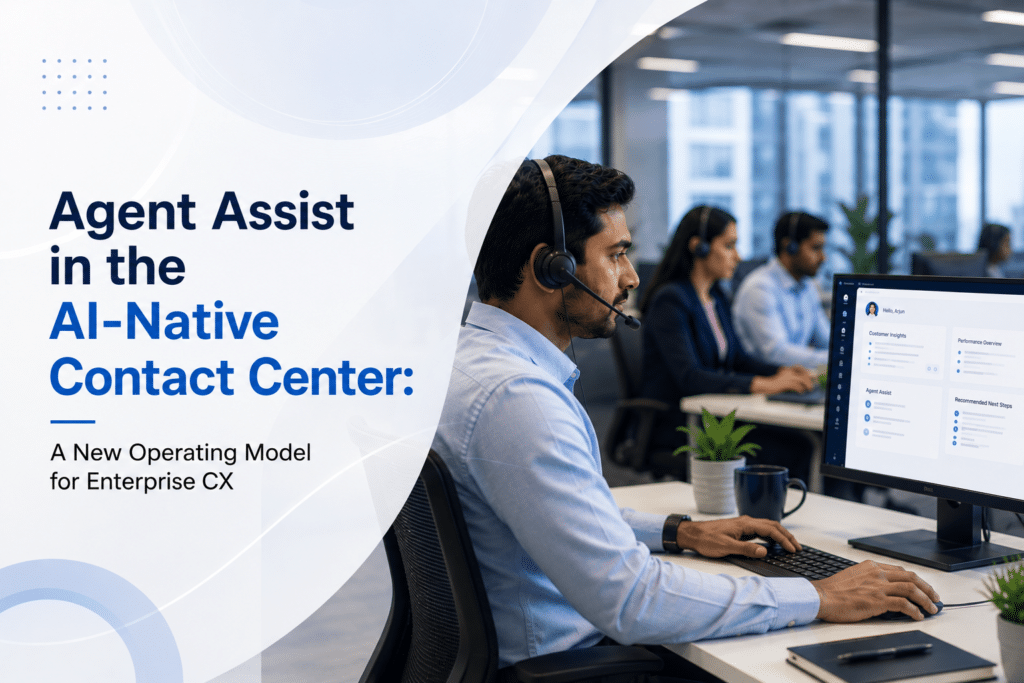
Enterprise contact centers are entering a phase where AI is no longer limited to chat bots or automated responses. The bigger transformation is happening inside the agent workflow.
For years, agents have been expected to combine information from CRM systems, knowledge bases, call histories, policies, scripts, and multiple business applications while simultaneously managing an interaction. As enterprise operations become more complex, simply giving agents access to more tools is no longer enough.
This is where agent assist is becoming a critical component of the AI-native contact center.
Rather than functioning as another application on an agent’s desktop, AI Assist creates an intelligence layer between business information, live conversations, and human decision-making.
What Makes Agent Assist an Intelligence Layer?
Traditional contact center software is passive. It holds files, logs call and waits for someone to type a keyword into a search bar. An AI assist layer works actively within the conversation.
During a live call or chat, an AI-driven agent assist system monitors the dialogue, pinpoints customer intent, and surfaces the right policy or next step immediately. Agents get the exact context they need without leaving their primary screen.
Why Enterprise CX Needs This Change
Enterprise teams face operational hurdles that standard training programs cannot fix:
- Products, pricing plans and regional compliance rules update faster than training cycles can keep up.
- Frontline reps handle a wide variety of customer tiers and technical edge cases.
- Relying on pure memory leads to extended hold times, inconsistent answers and agent burnout.
A real-time agent assist setup addresses this directly. Instead of asking teams to memorize every operational scenario, it delivers verified company knowledge right when a customer asks for it.
Connecting the AI-Native Contact Center
An agent copilot works best when connected across the entire contact center infrastructure:
- CRM tools supply historical interactions and account status.
- Conversation analytics track customer sentiment and flow.
- Knowledge bases provide up-to-date procedures and product documentation.
- Quality management system tracks compliance boundaries and coaching opportunities.
- Automation tools handle post-call follow-ups and ticketing updates.
Bringing these elements together creates a single intelligence model rather than a disconnected stack of software tools.
AI + Human Expertise
The purpose of an AI-native setup is to support human agents rather than replace them.
AI copilot handles computational tasks like scanning policy documents, recognizing patterns across past calls and drafting case summaries. Human reps handle relational tasks like active listening, empathy, creative problem-solving and negotiation.
- AI engine strengths include instant data retrieval, intent detection, automated call summaries and guided next steps.
- Human strengths include emotional intelligence, managing complex edge cases, discretionary judgment and relationship building.
Dividing the work this way lets AI assist software handle data complexity while agents focus on customer care.
What Enterprises Should Look for in Agent Assist Tool
When evaluating an AI assist tool for agents, organizations should look for capabilities that improve daily operations:
- Live transcription with accurate intent detection across natural phrasing.
- Contextual knowledge retrieval that surfaces direct answers rather than pages of search results.
- Next-best-action recommendations for multi-step troubleshooting.
- Automated call notes that sync directly to the CRM after wrap-up.
- Enterprise-level security, role-based access and sensitive data masking.
A New Operating Model for Enterprise CX
The shift underway is a move from application-heavy work to intelligence-driven work.
In older environments, reps acted as manual bridges between disjointed databases, finding data and deciding what to do next. In an AI-native environment, systems surface the relevant context automatically while the agent keeps full ownership of the interaction and final decision.
Conclusion
Agent assist represents a significant advancement in enterprise contact center operations, embedding actionable knowledge straight within live customer interactions. Through unified customer experience platforms such as Teckinfo, organizations can lessen the amount of administrative overhead, accelerate onboarding for new agents, and enable representatives to put their focus on delivering clear, effective customer service.
Frequently Asked Questions
What is the primary role of an AI sasist platform in a contact center?
Agent assist is a software solution that supports agents during live customer interactions. It interprets ongoing conversations, surfaces relevant documentation and automates post-call summarization in real time.
What are the key operational benefits of an agent copilot?
The benefits of agent assist include reduced handle times, decreased cognitive burden on representatives, accelerated onboarding, improved consistency in policy adherence and automated generation of case summaries.
How does real-time agent assist integrate with CRM and business systems?
Agent assist connects with CRM platforms, ticketing systems, and knowledge repositories through standard integrations. This helps deliver contextual information directly to the agent’s active interface.
What core capabilities should enterprises look for in an AI Copilot?
Enterprises should focus their attention on live intent recognition, contextual knowledge retrieval, next-best-action recommendations, automated call documentation and enterprise-grade data security.
How does an AI-driven agent assist framework support new team members?
Rather than requiring extensive memorization of policy manuals, agent assist provides real-time guidance in the middle of interactions, enabling new agents to address complex inquiries with greater confidence and accuracy.
What is the difference between an AI assist layer and a standard chatbot?
A chat bot interacts directly with customers to ensure self-service. Agent assist, on the other hand, operates in the background to support the human agent, who retains full control of the interaction.
Why is an agent copilot important for an AI-native contact centre?
AI assist brings closer the divide between backend customer contextual data and front-line customer interactions, providing representatives with immediate access to verified information.
How does AI-powered agent assist contribute to overall CX transformation?
By getting rid of manual research and repetitive documentation tasks, AI assist allows agents to put their attention towards active listening, problem resolution and relationship building with customers.